Wednesday, June 2, 2010

Stormy weather...and wine tasting

Memorial Day weekend is traditionally when all of the local wineries open up their tasting rooms and vineyards to tasting and tours. Just 20 miles from the center of Portland there are more than 50 established wineries and over 1,500 acres of vineyards! ( making our small 5 acre Pinot Gris block appear insignificant) It is also the time of year when our weather is unsettled...and in the throws of switching from our wet Winter and Spring to our dry endless Summer. This year the rains and cool weather have continued into June.

Needless to say, we rarely have the time to go and explore other vineyards. Along with friends, Barb and Roger, we headed out to visit three of our favorite fellow winemakers. First stop was at Beran Vineyards, just a few miles down the road from us. Surrounded by bright red clover fields and old walnut orchards, the rolling vineyard rows glowed with strips of bright green new foliage...looking much like our own. Bud break occurred back in early May, about two weeks late, and the leaves have been slow to emerge.


Bill and his wife Sharon have a small operation, but make wonderful Pinot Noir. The old farm, antique barn and winery are all just recently up for sale, and they are hoping to stay in the area on a smaller parcel of land. This is a reminder that having a vineyard or winery may sound romantic, but it involves a tremendous amount of work. We toasted to their future retirement years, where drinking the wine, not tending the vines will prevail!


Our next stop was the Italian inspired Alloro Winery, owned by our friend David. My husband Fred goes by the vineyards weekly on his bike rides and we have always admired the buildings and plantings, which remind us of the places we've visited in Tuscany. The winery buildings and his recently built house are all done in stucco and stone, surrounded by herb plantings, and punctuated by large Italian cypress. There is a gorgeous patio with a stone fireplace and a formal herb garden with olive trees! My idea of paradise. Looking across the valley towards our hillside, the numerous cypress that he has planted at the edges of his vineyard blocks give a unique perspective to the landscape.
His tasting room is not open on a regular basis, so it is always a great opportunity to sample the wines and compare notes and vintages. Walking out into the vineyard we find the family dog has disappeared half way down a mole hole and is frantically digging in an attempt to catch the critter. The is a favorite activity for vineyard dogs! We had a labrador once who dug so deep that only his rear end was showing, making it hard to extricate himself from a near vertical position!

Besides the lab, a lovely butterscotch colored Italian breed stood patiently waiting by the tasting room door.


Many of the vineyards have copies of a book on vineyard dogs which has pictures and information on the numerous breeds and deeds of these valuable creatures. I have fond memories of our Labs and Rottweilers who spent many hours with us working in the vineyard ( and who especially enjoyed chasing deer and digging for gophers and moles!)

As a designer I have admired the small herb garden that Alloro has created next to the winery. Clipped hedges, a central fountain, and a four squared design of lavender, roses and olive sets the mood. Now if only we could get the sun to shine, the picture would be complete! At this time of year it has a habit in Oregon to tease us with short, eratic appearances. Better to come back in August.

Our final stop was at Willakenzie Estate Winery, located west of our Chehalem ridge. Founded by the Frenchman, Bernard LaCroute, and a Cornell classmate of mine, Ronnie LaCroute, the winery and vineyards are in a breathtaking location. The Estate was named after the soil type of the area. After tasting some of their new releases we go out into the vineyard with their assistant winemaker, Michael, to have a closer look. They are one of many wineries in Oregon who believe in sustainable viticulture, and organic farming practices. Out in the field Austrian Pea plants and grasses grow between the rows ( I grab a few for sketching back home!), a herd of long horned cattle grazes on the slope next to the vineyard blocks, and banks of solar panels are observed in the distance.


One of my favorite spots at Willakenzie is on the flat garden terrace located between the two production buildings. Brilliant green grass and white flowering shrubs lend a formality and elegance to the space. A large new stone terrace is being added that will bring you even closer to the sloped vineyard blocks, and open up additional views.


Having dodged raindrops and marveled at dramatic skies and sunlit hillsides, we reluctantly headed for home with our token wineglasses in hand. Not much will get done during the rest of the day!


Mt. Hood offers up a final show as the sun paints the tip and lower slopes with it's last fading light, and shadows break across the lower slopes. A perfect ending to a perfect day!


Cheers!


Friday, May 21, 2010

May flowers... The garden as ART.


We've had crazy weather lately ... changing from rain, hail, sun, and then back again within minutes! The plants must be a bit bewildered as to what season it is. At least during the showers and occasional downpours I am able to look out and view the profusion of flowers that have burst upon the scene to brighten an otherwise stormy, dark day. One of my favorites is the yellow rhododendron, Hotoi, which is the best I have seen it this year. The flowers are the clearest yellow, and the plant, now over 30 years old, is magnificent. It borders curved steps and is slowly being shaped into a tree form.


It sits across from my new 'Moss Garden' that is edged with the golden Hakonochloa grass. The tongue of grass that edged uphill from our sloped back lawn was slowly being shaded by the Maple, Walnut, and Cornus. Various mosses were creeping in and taking over.... so I let them! A birdbath and ceramic Salmon floating above a sea of Geranium macrorrhizum complete the picture.


A few rocks planted out from the former edge of the bed helps to diffuse the boundary. Our new water pagoda beckons the eye into the space behind the trees.


The pagoda is also a handy perch for any bird wanting a drink....you might say that it's a giant water fountain! It's also a wonderful place to sit on a hot day.... listening to the sound of water. I've added Japanese Painted ferns, Hellebores, and Hosta to the shaded areas and touches of Forget-Me-Not and grasses dot the sun speckled edge.
Further down the slope, a large pot sits under the Japanese Maple surrounded by a tapestry mix of groundcovers, and hugged by a twisted copper pipe that came from our old heat pump! ( Found objects are fun to use in the garden!)


On the East side of the house another colorful bed emerges from it's Winter mode. My lovely copper fern sparkles as the yellows and rusts of neighboring plants bring it to life. A scattering of the blue flowers of Forget-Me-Not echo the color. In the center of the bed the small leaves of Rosa glauca rise up in a bluish haze. Iris and Peony will soon take center stage, while the golds of Lonicera and Euphorbia polychroma provide highlights.

Other copper pieces in this bed include a spinning Tulip and a small flower and bird that doubles as a bird feeder. The Purple sage at the edge of the bed also picks up the darker colors of the copper. Across the lawn, an ornamental grass is awakening from it's bed in a large blue pot, and will soon cascade over the edge, mingling with the pale blue flowers of the traveling Forget-Me-Not, which appears in different spots each year!


Our natural world is an ever-changing palette, and the windows of our homes frame it all! Don't forget to look out once in awhile.

Tuesday, April 27, 2010

Tour de Lopez

Every April for the past four years we have gone up to the San Juan Islands ( northwest of Seattle) and participated in the 'Tour de Lopez' bike ride with friends from both Portland and Friday Harbor. It's a great ride put on by the Chamber of Commerce of Lopez Island.


Getting there is half the fun! It's about a 5 hour drive up to the ferry at Anacortes where we hoped to get on one of the few scheduled rides to Friday Harbor on San Juan Island. This is where our friends live, who retired up to the island over 10 years ago. We always try to get there a few hours early to secure a place on the 2:45 hour long 'express' run. Waiting in line with the other cars gives us a chance to catch up on some reading... or me a chance to do a quick sketch of the ferry dock. The weather is cool and cloudy. I notice lots of dogs and bikes coming along with all the other paraphernalia stuffed in the cars. Once on the ferry we meet up with another couple we know who will be sharing our friend's guest house with us. The ride is beautiful as the ferry meanders around Shaw and Lopez islands on it's way to the quaint village of Friday Harbor. To the East we catch glimpses of the snow capped North Cascades.

Once on the island we have a short 5 mile ride to our friend's house, which sits in a beautiful meadow punctuated with rock outcroppings and a view of the water. Nature at it's best.

We unload our bikes and gear and spend the rest of the day and evening catching up with old friends. The weather is not looking promising, with showers predicted on the day of the ride. There will be seven of us participating and we'll need to catch an early ferry over to Lopez the next morning.

Up early, we are disheartened to see a steady, cold rain falling and dark skies! It's obviously decision time! Some decide to brave the weather and bike the short distance to the ferry. A few of us, who would rather stay dry as long as possible, decide to accept the offer of a ride in the truck, which also serves as a bike transport.

An hour and 20 minutes later we arrive at the small ferry dock on Lopez. The sky at this point is just spitting rain and there are signs of some possible clearing. Once off the ferry we must climb up a long hill and then make our way to the park where we get our maps and wrist bands for the lunch and festivities after the ride. Three options are provided...an easy 10 miles, then 17, or the entire 32 mile ride. All have some hills and gorgeous scenery. 600-700 riders usually participate, but we notice that there seem to be fewer riders this time .... probably due to the weather. Four in our group decide to do the entire 32 miles and three of us go for the shorter 17 mile loop. Since we normally ride longer distances, these should be really enjoyable provided we aren't hit by a downpour!


Fortunately, the air is cool and the ride is invigorating, and luckily, not too wet! We ride past farms, ponds and beaches sprinkled with rocks and driftwood. A few rest stops along the way, one at an old one room school house, provide brownies, fruit and drink to restore energy levels. Riders pass with both small children and family pets sequestered in carts behind their bikes. Reclining bikes and tandem bikes mix with both old and new models of road and hybrid models. The roads are wet so everyone uses a degree of caution.
At the end of the ride in Lopez Village there are tents set up with food and drink, a terrific quartet playing for the crowd, and lots of happy people. The sun finally makes an appearance and helps warm us up. By mid afternoon we get back on our bikes for the 4 mile ride back to the ferry dock so we can catch the 3:45 back to Friday Harbor.

Waiting at the ferry dock a deep discussion takes place assessing how every one's equipment handled the ride.


Once back at Friday Harbor, the last five miles takes us back to our home at the guest cottage, where a celebratory meal awaits. What a great way to spend a weekend with friends!


The following morning we get the 11:05 ferry back to Anacortes and then drive back down to Portland, arriving home exactly 7 hours later.

Friday, April 2, 2010

March meandering....


The month of March is a blur... but luckily I brought my camera and my sketchbook along when we flew out of Portland on March first, headed for Florida and then the Caribbean. I absolutely love experiencing new environments... it's a sensory overload. Wouldn't it be wonderful if we could rotate people around the world to experience someone else's life? I'm sure it would help with world peace and understanding. I'm convinced that broadening your horizon is the best education you can get. Nowadays, the 'getting to' and the 'getting back' aren't necessarily enjoyable, but this time flying over 4,000 miles East went relatively smoothly ( aside from spending a long 8 hours in the San Juan airport when a storm delayed outgoing flights) Since our arrival back home late on the 17th, our 'catch up' activities have kept me from posting until now.


First of all.... we froze in Florida! My sister lives in Venice, on the Gulf Coast, where it's supposed to be balmy and warm for all of those Northerners who come down for a Winter break. NOT! Everyone was wearing fleece and had their heat turned on. Temperatures were in the 50's (F) and went down into the 30's some nights. It was too cold for my sister's parrot, Bud, to be outside. Forget the bathing suit or even trying to turn our sickly pale Oregon bodies into even a healthy beige! We did manage a brisk walk on the beach and bought our favorite coffee, 'Jamaican-Me-Crazy' , to take along on our upcoming sail. The good news : it appears that temperatures have warmed up a bit since we got home.


From Florida, our next stop was the Caribbean island of St. Lucia in the West Indies. Friends of ours from college spend half of the year on their 42 ' sailboat, and for the past decade we have been joining them for a week to 10 days of sailing adventures. ( only very good friends should attempt this! ) Getting to the Caribbean from Oregon is always the hard part!


Once on the boat we look foward to spending days without shoes, a watch, or much contact with the outside world. Temperatures this year were warmer than normal, never getting below 85 degrees F. day or night. Steady breezes, wearing as little as possible, and jumping in the water 3-4 times a day kept us cool. After exploring an old fort at the edge of Rodney Bay, we sailed North from St. Lucia to the French island of Martinique, and from there sailed from town to town along the West coast of the island.
Seeing the coastal towns from the water gives you an entirely new perspective... quite different from arriving by car. One of our first stops was the capital of Fort de France so we could check in with customs . I loved the bright colors that dominated the landscape of the area... both the painted buildings and the bright clothes of the beautiful people created a warm and happy atmosphere. Their food and craft markets were also wonderful places to explore and feel the pulse of daily life.


Anchored in the harbor with boats from Canada, Germany, France, and Finland surroundiing us, we could see the local residents bustling about in the intense heat of the mid-day. After a short dinghy ride to the dock, walking a few blocks to the local boat outfitter was like walking through an oven.... it takes awhile to acclimate to the heat of these islands. You also understand how the climate dictates a way of life that is more relaxed and slowed down!


One of my favorite towns was Saint Pierre, located further up the coast and sitting at the base of the volcano, Mt. Pelee. In 1902 the mountain exploded in a violent eruption of ash and gas that killed the entire population of the town of 30,000 people! ( actually only one person is said to have survived...a prisoner who was housed in a well protected cell!) The town was rebuilt using some of the few remaining stone walls that survived. We anchored in the harbor close to the main dock and beaches where we could see the local fisherman tending their nets.


We took a cab a few miles up onto the slopes of Pelee to visit the DePaz Rum Distillery, one of many in the area. Surrounded by acres of sugar cane fields, we could look across the landscape and see our sailboat as a tiny speck in the harbor below. Visiters are invited through a fascinating walking tour of the facility as trucks of sugar cane arrive to be crushed and processed.


Back on our boat, we could see the colorful houses lining the beaches encircling the harbor, some containing remnants of the old stone walls that remained standing in 1902. It appeared that fishing, rum, and tourism were the main economic building blocks in the area.


Mt. Pelee on a clear day overlooks the town and was the premier view from our boat, achored in 20 feet of clear blue water. The top of the mountain shows evidence of the violent ash and lava flows that descended upon the town in 1902. There is a road and then a trail up the mountain, but the hot temperatures kept us from attempting such a climb! Many of the remains of the old stone walls were scattered about the town, making it a magical place where the past and present co-existed with nature.

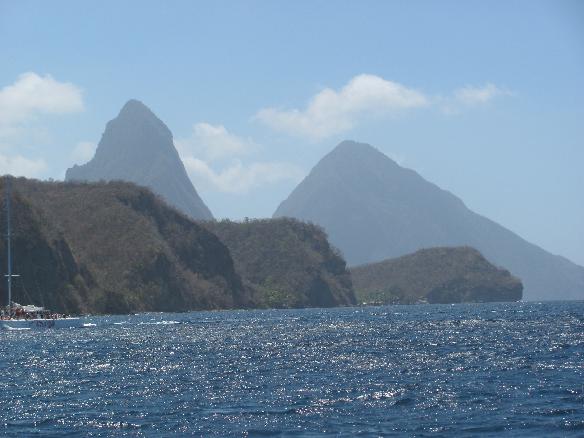
Upon leaving Saint Pierre we sailed South along the coast down to the town of Saint Anne. The following day we had a great 2-3 hour sail across open seas back to the island of St. Lucia, where we anchored for a day in the tiny harbor of Maribot Bay. Large yachts and an exclusive resort were hidden behind mangroves and palms. We had our only meal at a restaurant .....reached by dinghy, and called , appropriately, The Rainforest. Dining on a dock surrounded by mangroves , with the water lapping at your feet, is an experience not to be missed. Our final sail on our final day was down the coast to the famous 'Petons'...twin peaks that guard the entrance to a small harbor. The landscape is particularly dramatic, especially when seen from the water.

Our home for 10 days was Kewaydin, seen here at anchorage with sunshades keeping us as cool as possible when we're not sailing..


Monday, February 22, 2010

February wanderings


It's been over a month....but our Spring-like weather and an extended road trip kept me off the computer for awhile. We left Oregon on January 25th and drove South to Yosemite National Park. What a glorious place in the Winter! A fresh blanket of snow covered the valley floor and iced the surrounding rock formations. We stayed at the lodge near the base of Yosemite Falls and spent three days hiking and taking photos. The area had been hit by major snow and winds the week before and crews were busy cleaning up downed branches and storm debris. Each evening as the sun set, hoards of photographers would gather at the prime viewing areas to see what the ever-changing weather would bring. We hiked into Mirror Lake near the base of Half Dome, marveled at the architecture of the Ahwahnee Hotel over hot soup, and enjoyed the trails up to Bridalveil Falls and Yosemite Falls.


I only had time for one small sketch of the lovely old Ahwahnee Hotel, which opened in 1927.( plus my feet were cold standing in the foot deep snow!)


From there we drove down through the California central valley to Indio, where we spent a day exploring Joshua Tree National Park. The sun kept shining, with temps into the 70's during the day but getting quite cool at night. A three mile hike in the Mohave Desert to a hidden oasis of Palm trees, tucked into a small notch, was the highlight of the day. I loved the wonderful diversity in the landscape....from flat desolate sand reaching to the horizon, to piles of rounded rock, to forests of cactus....and, of course, the ever present Joshua Tree.


Just before leaving the park for the desolate 35 mile drive out to the south entrance, we spotted a forlorn looking Coyote making his way across the road. I wondered just how many animals prowled this vast desert without ever being seen. We were, after all, very unequipped intruders to this special environment.


Our only mishap was when Fred inadvertently stepped on a piece of spiny cactus and , in trying to get it off of his sandal, managed to get it stuck on his finger. Not a pretty sight! I cringed at the thought of having your entire body make contact with a fuzzy 'Teddy Bear' Cholla!


From Joshua we drove into Arizona and headed for the red hills of Sedona, where we spent the night at a B&B adjacent to many of the canyons. We spent the next morning hiking into Fay Canyon, before heading South for our final stop .... Tucson!


We stayed with good friends from college,spending four days exploring the surroundings. Our son had gone to college there years before so we were aware of some of the attractions. Besides taking a 26 mile bike ride on a borrowed tandem, we spent a day touring Biosphere2, and an afternoon at the Desert Museum....both fascinating to anyone interested in our environment and it's inhabitants. The museum had been expanded since our last visit, and we especially liked the beautiful Mt. Lion who posed so regally for us. ( it's been rumored that one exists on our hilltop in Oregon preying on the numerous deer in our neighborhood!) Along with large, natural enclosures for the animals, the many varieties of desert plants were on display. We had a great lunch out on an enclosed patio surrounded by vibrant colors and textures. I really wanted to set up camp there!

We finally started the drive North, heading across the desert from Tucson over to the Great Salton Sea, then passing through Palm Springs and Indio during a torrential downpour, and making it all the way up to Stockton before quiting for the night. Another full day of driving brought us back to our home on the hill in Oregon. It appeared that Spring had arrived in February this year, with temperatures in the 60's greeting us.

The weather has been wildly mixed up around our country this year....how do you explain it when it's colder in Florida than Oregon, and when California is getting more rain than we are!? I know we'll still have some cold and wet days ahead, so I'm not rushing to put down seeds or new plants. Our adventure South just made me appreciate our natural world.....and I hope and pray that my grandchildren will be able to do the same in the future.


A Tucson door